LoraDB v0.3: snapshots for saving and restoring graph state

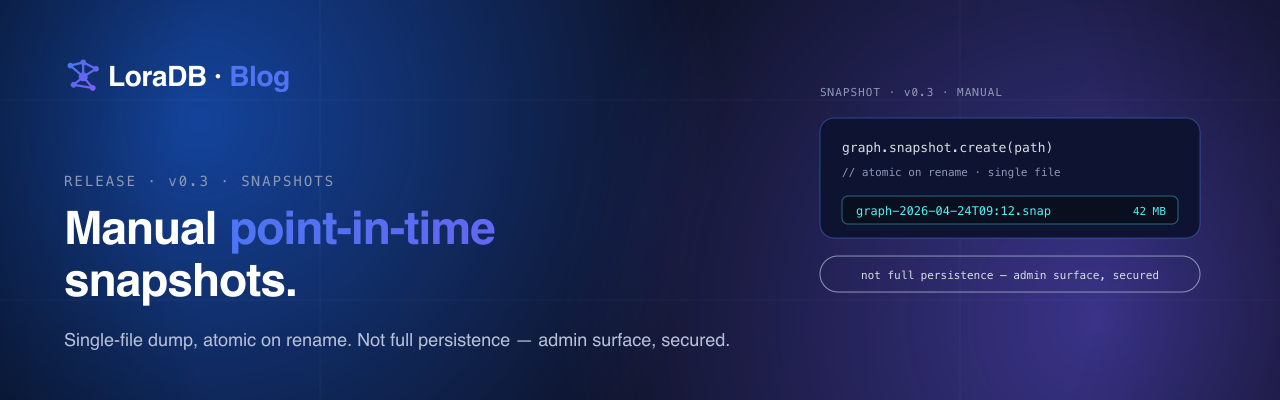
LoraDB v0.3 adds manual point-in-time snapshots.
This release note is historical, but the snippets below have been
updated to the current snapshot API. Current releases write the
columnar LORACOL1 database snapshot format, support compression and
encryption options, expose WASM snapshots through saveSnapshot /
loadSnapshot, and can pair snapshots with WAL-backed checkpoints.
You can now dump the entire in-memory graph to a single file and restore it later. The save is atomic on rename, the load replaces the live graph in one shot, and the feature is exposed on every surface that the engine talks through — the Rust core, the Python, Node, WASM, Go, and Ruby bindings, the shared C FFI, and the HTTP server as an opt-in admin endpoint.
What this release is not is full persistence. There is no write-ahead log, no background checkpoint loop, no continuous durability. A snapshot is exactly what the name says: a point-in-time dump you take on demand. Data mutated between two saves is lost on crash. That boundary is deliberate — making the explicit, operator- controlled shape work cleanly is the foundation a WAL will sit on, and it closes the "no persistence at all" gap for the workloads that only need occasional checkpoints today (seeded services, notebooks, controlled shutdowns, scheduled backups).
What Changed
The short list:
- A new single-file snapshot format. v0.3 introduced the original
LORASNAPformat; current releases write the columnarLORACOL1format with a BLAKE3 envelope checksum, compression metadata, and optional encryption metadata. - Atomic saves — writes go to
<path>.tmp, arefsync'd, and then renamed over the target. A crashed save never leaves a half-written file at the target path. - Atomic loads — the store mutex is held for the full restore, so concurrent queries see the old or the new graph, never a partial one.
- A
walLsnmetadata slot for WAL/checkpoint recovery. Pure snapshots emit it asnull; checkpoint snapshots written by WAL-backed surfaces stamp it with a durable fence. - Forward-compatible reader — formats are dispatched by version, so today's v1 files will keep loading after the next format bump until support is deliberately dropped.
- Snapshot metadata (
formatVersion,nodeCount,relationshipCount,walLsn) returned from path-based saves, load calls, and HTTP admin calls. Byte-output save helpers return bytes.
Binding support, using today's API names:
| Surface | Save | Load | Shape |
|---|---|---|---|
Rust (lora-database) | save_snapshot_to(path) | load_snapshot_from(path), in_memory_from_snapshot(path) | file path |
Python (sync Database) | save_snapshot(path) | load_snapshot(path) | file path |
Python (AsyncDatabase) | await save_snapshot(path) | await load_snapshot(path) | file path |
Node.js (@loradb/lora-node) | await saveSnapshot(path) | await loadSnapshot(path) | file path |
WebAssembly (@loradb/lora-wasm) | await saveSnapshot() | await loadSnapshot(source) | Uint8Array, ArrayBuffer, Blob, Response, URL, stream |
Go (lora-go) | db.SaveSnapshot(path) | db.LoadSnapshot(path) | file path |
Ruby (lora-ruby) | db.save_snapshot(path) | db.load_snapshot(path) | file path |
C FFI (lora-ffi) | lora_db_save_snapshot(handle, path, ...) | lora_db_load_snapshot(handle, path, ...) | file path |
HTTP server (lora-server) | POST /admin/snapshot/save | POST /admin/snapshot/load | file path on the server's disk |
WebAssembly is source/byte-oriented by design — WASM has no filesystem
path API, so the caller is responsible for persisting the Uint8Array
or web-native wrapper to IndexedDB, OPFS, a backend upload, or wherever
their app already stores state.
Why Snapshots Matter
The v0.1 and v0.2 model was "one process, one in-memory graph, lost on exit." That is fine for notebooks, tests, demos, and embedded read-mostly caches, but it forces every operator into one of two patterns neither of which the engine supported well:
- Reload from source on every boot. Works if the source is cheap, but adds real seeding time on restart and pushes reload logic into every deployment.
- Rebuild a parallel persistence layer. The application writes every mutation to an external store, then replays it on boot. A second data model to maintain, a second consistency story.
Neither is what you want for the shape of workload LoraDB is actually good at: a graph view over data the host process already owns, or a small seeded context that the agent / service accumulates in memory. For those, the right primitive is a file on disk that captures "the graph as of this moment" — cheap to take, cheap to restore, no second data model.
That is what v0.3 ships. The Cypher surface does not change; the
storage tier gets one save verb (save_snapshot), one load verb
(load_snapshot), and one new file on disk.
What A Snapshot Is Not
Same list as above, stated as the bright line:
- Not continuous durability by itself. A crash between two saves loses every mutation in the window. Current releases can pair snapshots with WAL-backed recovery when you need committed writes to survive crashes.
- Not a wall-clock checkpoint scheduler. Manual saves happen because the host process, an external cron, or the admin HTTP endpoint calls them. Current raw-WAL helpers can also write managed snapshots after N committed transactions.
- Not a general persistent storage tier. There is no storage backend other than the in-memory graph; the snapshot is a dump of that graph, not a format a different engine writes into.
- Not zero-cost at save time. The store mutex is held for the duration of the save. Concurrent queries wait. Pick a snapshot cadence that leaves headroom.
- Not a boundary for multi-tenancy. One process still holds one graph; each process needs its own snapshot path.
Those are not roadmap omissions hidden behind marketing language. They are what "simple, explicit, operator-controlled" means.
Using Snapshots
Save and load from Rust
The reference surface. Every other binding wraps these two methods.
use lora_database::Database;

let db = Database::in_memory();
db.execute("CREATE (:Person {name: 'Ada'})", None)?;

// Dump the full graph to disk.
let meta = db.save_snapshot_to("graph.bin")?;
println!(
    "{} nodes, {} relationships",
    meta.node_count, meta.relationship_count,
);

// Boot a fresh Database directly from the file.
let db2 = Database::in_memory_from_snapshot("graph.bin")?;

// Or restore onto an existing handle (concurrent queries block on the
// store mutex for the duration of the load).
db.load_snapshot_from("graph.bin")?;
Every save and load returns a SnapshotMeta:
{
  "formatVersion": 1,
  "nodeCount": 1024,
  "relationshipCount": 4096,
  "walLsn": null
}
The walLsn field is null for pure snapshots and non-null for
checkpoint snapshots written by WAL-backed surfaces.
Save and load from Python
from lora_python import Database

db = Database.create()
db.execute("CREATE (:Person {name: 'Ada'})")

meta = db.save_snapshot("graph.bin")
print(meta["nodeCount"], meta["relationshipCount"])

db2 = Database.create()
db2.load_snapshot("graph.bin")
The AsyncDatabase wrapper exposes the same two methods as
coroutines:
import asyncio
from lora_python import AsyncDatabase

async def main():
    db = await AsyncDatabase.create()
    await db.execute("CREATE (:Person {name: 'Ada'})")
    await db.save_snapshot("graph.bin")

asyncio.run(main())
Both forms run with the GIL released / on a worker thread so the event loop stays free during large saves.
Save and load from Node / TypeScript
import { createDatabase } from '@loradb/lora-node';

const db = await createDatabase();
await db.execute("CREATE (:Person {name: 'Ada'})");

const meta = await db.saveSnapshot('graph.bin');
console.log(meta.nodeCount, meta.relationshipCount);

const db2 = await createDatabase();
await db2.loadSnapshot('graph.bin');
saveSnapshot / loadSnapshot return Promises that resolve to a
SnapshotMeta object with the same formatVersion / nodeCount /
relationshipCount / walLsn fields as every other binding.
Save and load from WebAssembly
WASM has no filesystem path API, so the snapshot API is source-in / byte-out:
import { createDatabase } from '@loradb/lora-wasm';

const db = await createDatabase();
await db.execute("CREATE (:Person {name: 'Ada'})");

// Dump the graph to a Uint8Array.
const bytes: Uint8Array = await db.saveSnapshot();

// Persist the bytes wherever you already store state — IndexedDB,
// localStorage, a POST to your backend, `fs.writeFileSync` in Node.
// Later:
const db2 = await createDatabase();
await db2.loadSnapshot(bytes);
saveSnapshot can also return ArrayBuffer, Blob, Response,
ReadableStream, or an object URL; loadSnapshot accepts URL,
Uint8Array, ArrayBuffer, Blob, Response, or
ReadableStream<Uint8Array | ArrayBuffer>. The Worker-backed surface
(createWorkerDatabase) exposes the same saveSnapshot /
loadSnapshot methods.
Save and load from Go
import lora "github.com/lora-db/lora/crates/bindings/lora-go"

db, err := lora.New()
if err != nil { log.Fatal(err) }
defer db.Close()

if _, err := db.Execute("CREATE (:Person {name: 'Ada'})", nil); err != nil {
    log.Fatal(err)
}

meta, err := db.SaveSnapshot("graph.bin")
if err != nil { log.Fatal(err) }
fmt.Printf("nodes=%d rels=%d\n", meta.NodeCount, meta.RelationshipCount)

db2, err := lora.New()
if err != nil { log.Fatal(err) }
defer db2.Close()

if _, err := db2.LoadSnapshot("graph.bin"); err != nil {
    log.Fatal(err)
}
The Go FFI header (crates/bindings/lora-go/include/lora_ffi.h) now declares
lora_db_save_snapshot / lora_db_load_snapshot alongside a
LoraSnapshotMeta struct; the Go wrapper turns that into an idiomatic
*SnapshotMeta with a nullable WalLsn pointer.
Restoring And Saving Through The HTTP Server
lora-server exposes two opt-in admin endpoints for snapshot
operations. They do not exist unless the server is started with
--snapshot-path:
lora-server \
  --host 127.0.0.1 --port 4747 \
  --snapshot-path /var/lib/lora/db.bin \
  --restore-from  /var/lib/lora/db.bin
--snapshot-path <PATH>mountsPOST /admin/snapshot/saveandPOST /admin/snapshot/loadagainst this file. Without the flag the routes return404— the admin surface is off by default.--restore-from <PATH>loads a snapshot at boot before the server accepts queries. A missing file is fine (empty graph, logged); a malformed file is fatal.
Once enabled, saving and restoring is a plain HTTP call:
curl -sX POST http://127.0.0.1:4747/admin/snapshot/save
# => {"formatVersion":1,"nodeCount":1024,"relationshipCount":4096,"walLsn":null,"path":"/var/lib/lora/db.bin"}

curl -sX POST http://127.0.0.1:4747/admin/snapshot/load
Both endpoints accept an optional { "path": "…" } body to override
the configured default for a single request — useful for ad-hoc
backups to a rotated filename:
curl -sX POST http://127.0.0.1:4747/admin/snapshot/save \
  -H 'content-type: application/json' \
  -d '{"path": "/var/backups/lora/2026-04-24.bin"}'
--restore-from is independent of --snapshot-path. You can restore
from a read-only seed and save to a writable runtime path:
lora-server \
  --restore-from  /var/lib/lora/seed.bin \
  --snapshot-path /var/lib/lora/runtime.bin
The admin endpoints have no authentication, and the optional
path body field is passed straight to the OS. Any client that can
reach the admin port can write files anywhere the server UID can
write, or swap the live graph by pointing load at an attacker-staged
file. Do not expose the admin surface on a network-reachable host
without authenticated ingress in front (a reverse proxy with auth, a
Unix socket, or simply not binding the port at all). Future releases
may add authentication; until then, the correct deployment is "admin
surface disabled by default, enabled only behind an auth boundary".
Why Snapshots Are Useful With Or Without A WAL
A snapshot is not a replacement for continuous durability, but it closes enough of the gap for many workloads. When paired with WAL, snapshots become the checkpoint artifact that keeps replay bounded:
- Seeded services. Build the graph offline from a cheaper source (SQL exports, a scrape, an ETL job), snapshot it, and ship the snapshot alongside the deployment. Every restart boots in one file-read rather than a multi-minute replay.
- Notebooks and research tooling. Save the graph you've curated at the end of a session; reload it the next morning with one call.
- Agents and LLM context stores. Periodic snapshots of the working graph give you trivial "go back to yesterday's state" without the complexity of a full transactional store.
- HTTP operator loop.
ExecStop=curl … /admin/snapshot/saveon a systemd unit gives a graceful-shutdown save without any new tooling. Add a--restore-fromon boot and you have a durable- enough deployment for a single-node service. - Scheduled backups. A cron that calls
POST /admin/snapshot/saveevery N minutes, optionally with a rotating{"path": "…"}, is a complete backup policy for small graphs.
The bright line is still the same: a crash between saves loses every mutation in the window. The question to ask is whether that window is narrow enough for your workload. For most of the shapes above, it is.
What's Still Out Of Scope
Explicitly not in this release, so the feature stays honest about its boundary:
- Snapshots alone are still not a WAL. Current releases have WAL-backed recovery on filesystem-backed surfaces, but a manual snapshot by itself is still only point-in-time persistence.
- No wall-clock scheduler. Manual snapshots run when you call them. Raw-WAL helpers can write managed snapshots after N committed transactions; wall-clock scheduling is still host/operator work.
- No partial / incremental snapshots. A save serializes the whole graph. For v0.3 the expected scale is graphs that fit in memory comfortably and dump in seconds.
- Non-blocking save. The store mutex is held for the full save. Concurrent queries block. Real per-mutation copy-on-write will come with deeper storage-engine work.
- No multi-graph file format. One file, one graph — same one-process model as the rest of the engine.
- No auth on the HTTP admin surface. Opt-in, off by default, and still not safe on a network-reachable host without an ingress.
Those are the things a future release will address. They are not hidden in the implementation — every one of them is a place the docs say so.
Try It
Get the repo, build, and snapshot:
cargo run -p lora-server -- \
  --snapshot-path /tmp/loradb.bin \
  --restore-from  /tmp/loradb.bin
Then from a second shell:
curl -sX POST http://127.0.0.1:4747/query \
  -H 'content-type: application/json' \
  -d '{"query":"CREATE (:Person {name:\"Ada\"})"}' > /dev/null

curl -sX POST http://127.0.0.1:4747/admin/snapshot/save
# => {"formatVersion":1,"nodeCount":1,"relationshipCount":0,"walLsn":null,"path":"/tmp/loradb.bin"}
Stop the server, start it again with the same flags, and the graph is still there.
The docs site has a dedicated page for snapshots — the file format, atomicity guarantees, binding examples, and the full HTTP admin surface:
What Comes Next
Three directions stood out after v0.3:
- A WAL. This has since landed on every filesystem-backed
surface, with Rust and
lora-serverexposing the full operator controls and embedded bindings exposing raw-WAL helpers. - Checkpoint automation. Current raw-WAL helpers can write managed snapshots after N committed transactions. Wall-clock scheduling remains a host/operator concern.
- Auth on the admin surface. Token-based auth in front of
/admin/*so the endpoints can be used on network-reachable hosts without an external reverse proxy.
If you try v0.3 with snapshots, the feedback that will shape those is concrete:
- how large does your graph get, and how long does
save_snapshottake at that size; - what cadence did you end up running — seconds, minutes, on shutdown only;
- did the atomic-rename guarantee land cleanly on your filesystem (we've tested on Linux ext4/xfs and macOS APFS);
- what does your ingress look like for the admin endpoints;
- which binding did you use, and did the byte-based WASM surface fit your storage layer (IndexedDB, OPFS, a backend POST) without extra glue.
That is the feedback that will shape v0.4.