LoraDB v0.17: inside lora-graphql

v0.16 introduced @loradb/lora-graphql. This post is about how it
works: what happens between an annotated schema and the Cypher that
reaches the engine, and why it is built that way.
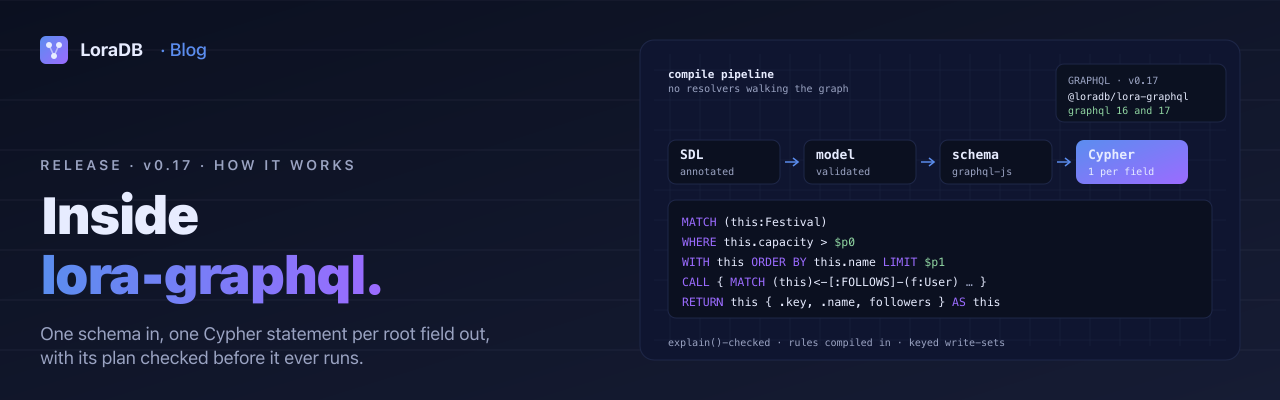
The short version: there are no resolvers that walk the graph. A GraphQL operation is compiled, root field by root field, into one parameterised Cypher statement whose plan can be checked before it ever runs.
From SDL to a model
Everything starts with type definitions like these:
type Claims @jwt {
  sub: String!
  roles: [String!]
}

type Festival
  @node
  @mutation
  @authorization(
    filter: [
      { requireAuthentication: false, where: { node: { published: { eq: true } } } }
      { where: { jwt: { roles: { includes: "editor" } } } }
    ]
  ) {
  key: String! @key
  name: String! @filterable(byValue: [EQ, CONTAINS]) @sortable
  published: Boolean! @default(value: false)
  capacity: Int @filterable(byValue: [GT, LT])
  followers: [User!]! @relationship(type: "FOLLOWS", direction: IN, properties: "Follows")
}
The first thing the library does with them is not build a GraphQL schema. It builds a model: a plain, validated description of labels, properties, keys, relationships, rules and the API surface. Every later stage reads the model and nothing else.
Validation happens here, all at once. A rule that names a field the
type does not have, a claim the @jwt type does not declare, a
required relationship that no mutation could ever set, or a directive
that means nothing where it is written: each becomes one entry of a
single ModelError, located by type and field. Nothing is accepted
and silently ignored. If the model builds, the API it describes is
one the library can actually enforce.
From the model to a schema
The generated GraphQL schema is derived from the model: object types,
where and sort inputs with only the operators each field opts into,
connections, aggregates, and the mutation inputs. It is plain
graphql-js, served by Yoga, Apollo or anything else, and it works with
graphql 16 and 17.
Inputs are generated from what the model allows, not from the SDL's
shape. A field that is @settable(onUpdate: false) is not in the
update input, so a client that sends it gets a validation error, not
a silent overwrite. An input that would end up with no field is left
out, together with the argument or mutation that would take it, and
getSchema() validates the result, so a model that builds never
produces a schema that fails at request time.
The same model also says which indexes the API needs. A key needs a
constraint, GT and @sortable need a RANGE index, CONTAINS needs
a TEXT index. requirements() lists them with the reason for each, and
assertSchema({ create: true }) creates them.
One statement per root field
The resolvers the schema carries do one thing: compile the root field they sit on and run the result. Take this query:
{
  festivals(where: { capacity: { gt: 1000 } }, sort: [{ name: ASC }], limit: 10) {
    key
    name
    followers(limit: 3) { name }
    followersConnection { totalCount }
  }
}
For an anonymous request it compiles to one statement (the connection's bookkeeping fields are abridged here):
MATCH (this:Festival)
WHERE this.capacity > $p0 AND this.published = $p1
WITH this ORDER BY this.name ASC LIMIT $p7
CALL {
  WITH this
  MATCH (this)<-[:FOLLOWS]-(this_followers:User)
  WITH this_followers ORDER BY this_followers.key ASC LIMIT $p2
  RETURN collect(this_followers { .name }) AS this_followers_list
}
RETURN this {
  .key, .name,
  followers: this_followers_list,
  followersConnection: {
    __totalCount: size([(this)<-[:FOLLOWS]-(:User) | 1]), …
  }
} AS this
A few rules shape every statement the compiler writes:
- Page first, then project. The root page is sorted and limited in a
WITHbefore anything nested runs, so nested work happens for ten festivals, not for every one that matched. - Nested lists in
CALL { }. A subquery per nested list is the one way to sort, limit and aggregate per parent. - Counts as pattern comprehensions.
size([(this)<-[:FOLLOWS]-() | 1])instead ofOPTIONAL MATCH, which multiplies rows. - Every value a parameter. Values never become statement text, and identifiers only ever come from the model, escaped. Statement text depends on the shape of the request, not on its values, so the engine's plan cache is hit for every repeat.
- Absent filters are absent. A filter the client did not send is
left out of the statement, never written as
($p IS NULL OR …), so the planner sees every predicate that is there.
Before the statement runs, the compiler has also estimated its cost:
rows touched, multiplied through nested page sizes and capped by
@cardinality or sampled degrees. An operation over maxCost fails
with COST_EXCEEDED without touching the database.
Authorization is compiled, not evaluated
The query above ran anonymously. Here is the same field for a caller
whose token carries the editor role:
MATCH (this:Festival)
WHERE this.capacity > $p0
WITH this ORDER BY this.name ASC LIMIT $p7
…
The published = true test is gone. A rule is { node, jwt, AND, OR, NOT }, and its two halves are treated differently:
- The
jwthalf reads only the request's claims, so it is decided in JavaScript while compiling. The editor's rule folds to true, which grants, and the other rule's predicate disappears. - The
nodehalf becomes a predicate in the statement, with claims bound as parameters:{ node: { owner: { eq: "$jwt.sub" } } }becomesthis.owner = $p0. From v0.17 a claim can also sit inside a longer string,key: { startsWith: "${jwt.sub}:" }, which ties a client-chosen key to its owner.
Because rules live in the statement, a list, a count, an aggregate, a nested relationship, a cursor and a subscription event all see the same rows. There is no second code path that could forget a filter.
Missing claims get care of their own. A test that needs a claim the
token lacks is unknown: false where it stands, and a NOT around it
cannot turn it into a grant. Claim paths read own properties only, so
$jwt.constructor resolves to nothing.
Field-level rules compile per row. A field guarded by a READ rule is
projected as CASE WHEN <rule> THEN <value> ELSE { __forbidden: true } END, and the field's resolver turns the marker into a FORBIDDEN (or,
without a token, UNAUTHENTICATED) error for that row only. The
statement has the same shape with or without a token, which matters
for the next part.
Plans are checked, not hoped for
Each compiled statement carries the access path it was written for:
"an exact seek on :Festival by key", "a range seek for
capacity > …". lora.explain() asks the engine for its plan and
compares. A label scan where a seek was expected, a mutating plan
behind a read, or result columns that do not match are findings.
lora-graphql check runs this in CI over your operations, on an
in-memory database with the schema asserted:
lora-graphql check schema.graphql --operations src/graphql \
  --context ctx.json --baseline plans.json --row-budget 5000
--baseline fails the build when an operation's plan changes, so a
plan regression shows up in review like any other diff. --context
compiles operations as a signed-in caller would. Only the root field's
own access path is judged: a scan inside a @cypher statement's
subquery is reported as a lint note for its author, not blamed on the
root.
Mutations know what they wrote
Mutations are keyed. update, delete, connect and disconnect
address nodes by @key, and bulk mutations resolve their where to
keys first, under the same rules, before doing anything. That gives
every mutation an exact write-set: which nodes were created,
updated and deleted, and which relationships were connected and
disconnected.
A mutation is planned from its input, then run in one interactive
transaction. The statements are batched by shape, one UNWIND for all
rows that look alike:
UNWIND $p0 AS row
MATCH (a:Festival) WHERE a.key = row.from
MATCH (b:User) WHERE b.key = row.to
WITH a, b, row, size([(a)<-[:FOLLOWS]-(b) | 1]) > 0 AS existed
MERGE (a)<-[r:FOLLOWS]-(b)
ON CREATE SET r += row.defaults
SET r += row.props
RETURN row.from AS from, row.to AS key, existed
That one statement connects any number of pairs. Each seek sits in its
own MATCH, so it never depends on the optimizer finding it. @default
properties apply only when the relationship is created, and
existed tells a new relationship from a re-connected one, for the
counts and for rules that differ between creating and updating a
property.
Then come the checks Cypher cannot express as constraints: a single
relationship holds one node from whichever side it was written, a
required relationship stays set, and AFTER rules hold for what was
written. Each is a statement in the same transaction, and a failure
rolls everything back. An identical re-upsert of 200 rows runs six
statements and writes nothing.
The write-set feeds onWrite and subscriptions. With
changeFeed: true, subscriptions are fed from the engine's committed
change feed instead, so they also see writes made by hand-written
Cypher.
Compile once, run many
Compiling a nested page takes a fraction of a millisecond, and the
result is cached anyway. The cache key is the field's node in the
parsed document, the variables, the claims, and the values of every
$context path the rules actually read. Persisted operations skip
parsing and validation altogether: lora.persist() validates them at
startup, and lora-graphql compile emits the manifest and TypeScript
types for them at build time.
Also in v0.17
Most of this release came from running lora-graphql under a real
application's whole API. In the library:
- Rules on relationship properties,
@settableand@readonlyon relationship fields, and@timestampon relationship properties are enforced; a re-connect keeps a relationship's properties. ${jwt.path}and${context.path}inside rule strings, as above.check()takes a GraphQL context per operation, and field rules no longer stop anonymous plan checks.- The test suite runs on graphql 16 and 17;
compile(),explain()andcheck()read variables correctly on 17. - Disconnects are batched, generated types merge fields selected twice,
@storedAsscalars keep their SDL description, and@cyphercolumn inference understands commas inside calls.
In the engine:
<,<=,>and>=compare lists element by element, so[a, b] > $cursorworks. Integers compare exactly above 2^53.first()is accepted as the standard name forhead().- A
WITH ... WHEREpredicate that uses a projected variable only inside a pattern, such asWITH a WHERE size([(a)<-[:T]-() | 1]) = 0, now runs after theWITH. It used to run before it, withaunbound, and returned no rows.
Behaviour changes
- An ordering comparison between values that cannot be ordered against
each other (
1 < 'a', aDATEagainst aDATETIME) returnsnull, as Cypher specifies, instead offalse. UnderNOTthat is the difference between keeping and dropping a row. - In
lora-graphql, an anonymous request that selects a field guarded by a READ rule gets anUNAUTHENTICATEDerror on that field, with the rest of its data, instead of an error for the whole root field.
The GraphQL docs cover every directive, and the translation rules page lists each Cypher shape the compiler uses and the measurement behind it.