9 posts tagged with "Architecture"

How LoraDB is built — crates, pipeline, internals.

View All Tags

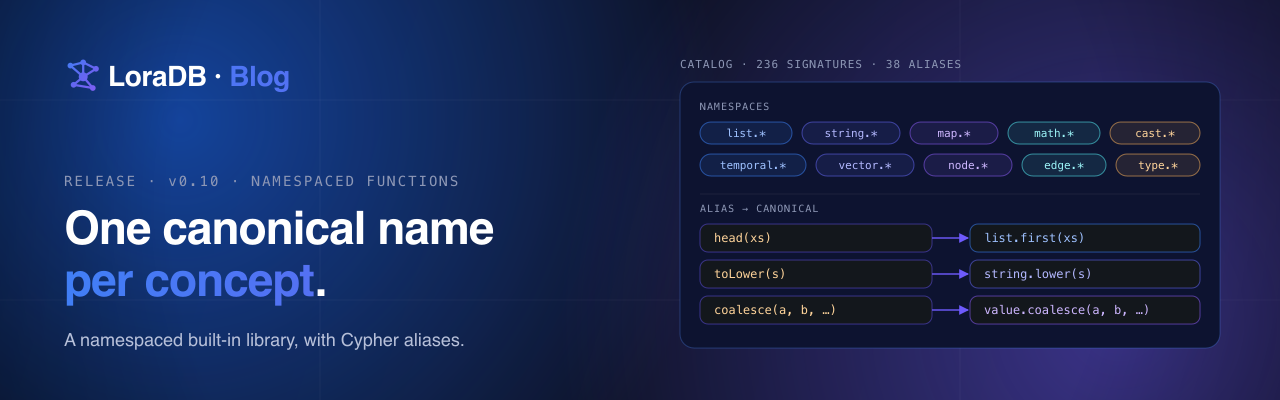
LoraDB v0.10: one canonical name per concept

· 10 min read
The LoraDB team
Engineering

LoraDB v0.10 — one canonical name per concept.

LoraDB v0.10 is a function-surface release.

v0.5 made the engine stream. v0.6 made persistence feel like a system. v0.7 was a process release. v0.8 made the planner and executor observable. v0.9 gave the planner a real schema catalog.

v0.10 does the same thing for the function library: the engine now has one canonical name per concept, grouped into namespaces, with the analyzer, executor, optimizer, docs, and binding tests all reading from the same table.
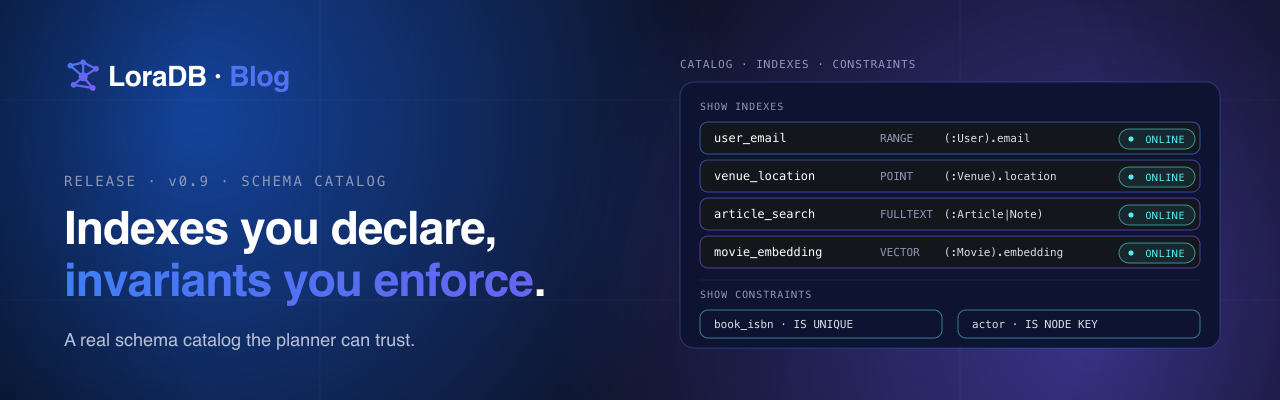

LoraDB v0.9: indexes, constraints, and a real schema catalog

· 8 min read
The LoraDB team
Engineering

LoraDB v0.9 — indexes, constraints, and a real schema catalog.

LoraDB v0.9 is a schema-catalog release.

v0.5 made the engine stream. v0.6 made persistence feel like a system. v0.7 was a process release. v0.8 made the planner and executor observable. v0.9 closes the next gap: the planner now has a real schema catalog to plan against, and the engine has real constraints to enforce.

The result is a single coherent surface — index DDL, constraint DDL, catalog-backed scans, full-text and vector query procedures — wired through the parser, store, optimizer, executor, WAL, and snapshots.

Building LoraDB with Claude and Codex

· 5 min read
Joost van Berkel
Author, LoraDB

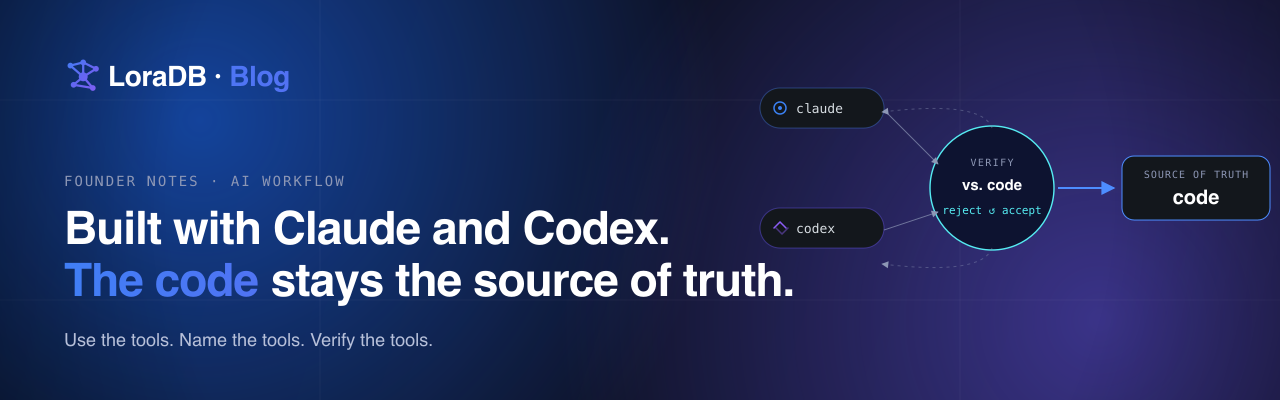
Built with Claude and Codex — the code stays the source of truth.

I use Claude and Codex to build LoraDB.

That is not a positioning statement or a shortcut around the work. It is simply part of how the project gets built.

Claude and Codex help with different parts of the process: reading code, checking assumptions, shaping docs, reviewing release work, and testing whether the project is saying things the implementation can actually support. They are useful tools, but they are not the source of truth.

LoraDB v0.7: AI-assisted engineering, honestly

· 5 min read
The LoraDB team
Engineering

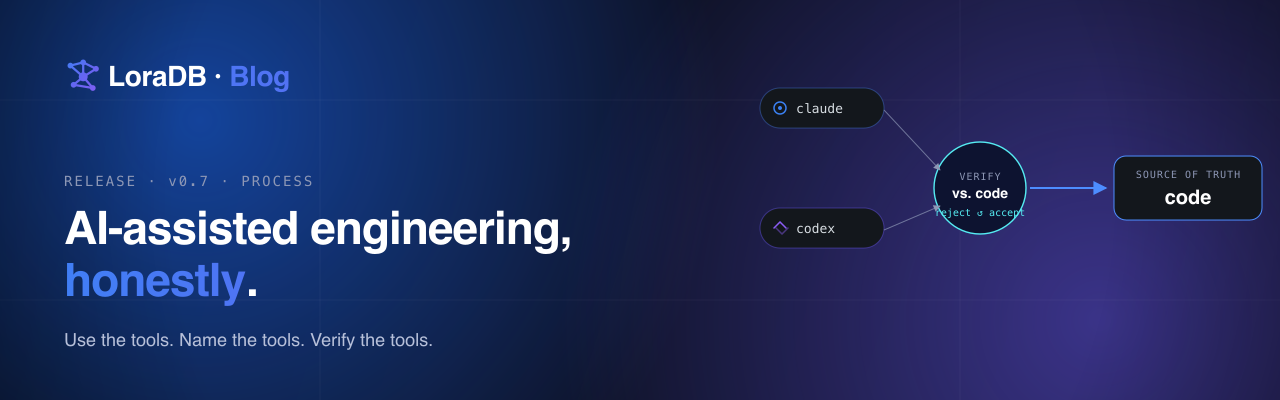
LoraDB v0.7 — AI-assisted engineering, honestly: use, name, verify the tools.

LoraDB v0.7 is about how the project is being built.

Claude and Codex are now part of the LoraDB engineering loop. Not as a mascot, not as a replacement team, and not as a way to avoid responsibility. They are used across the project: code review, refactoring, documentation, release work, architecture pressure, and product-direction thinking.

This release says that out loud.

The LoraDB release journey so far

· 5 min read
The LoraDB team
Engineering

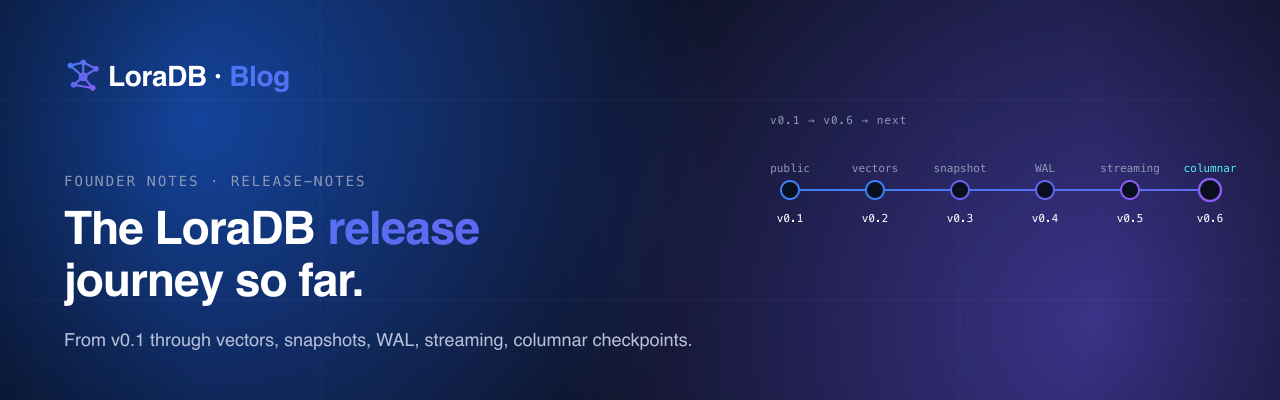
The LoraDB release journey — v0.1 through v0.6 milestones.

LoraDB has moved quickly since the public release, so it is worth stepping back from the version numbers and looking at the journey.

The individual posts tell the detail of each release. This one is the map: why the releases landed in this order, what each one proved, and how the current work fits the long arc from "fast local graph engine" to "database people can trust in the product loop."

LoraDB public release: a fast in-memory graph database in Rust

· 7 min read
The LoraDB team
Engineering

LoraDB public release v0.1 — a fast in-memory graph database in Rust.

LoraDB is now public.

It is a fast in-memory graph database written in Rust, with a Cypher-shaped query engine, an HTTP API, and bindings for Node.js, WebAssembly, and Python. It is built for developers who need relationship queries close to their application without adopting a large graph database stack on day one.

This release is the beginning of the public journey: source-available core, developer-first adoption, and a path toward a hosted platform for teams that want managed operations later.

From developer trust to hosted platform

· 5 min read
Joost van Berkel
Author, LoraDB

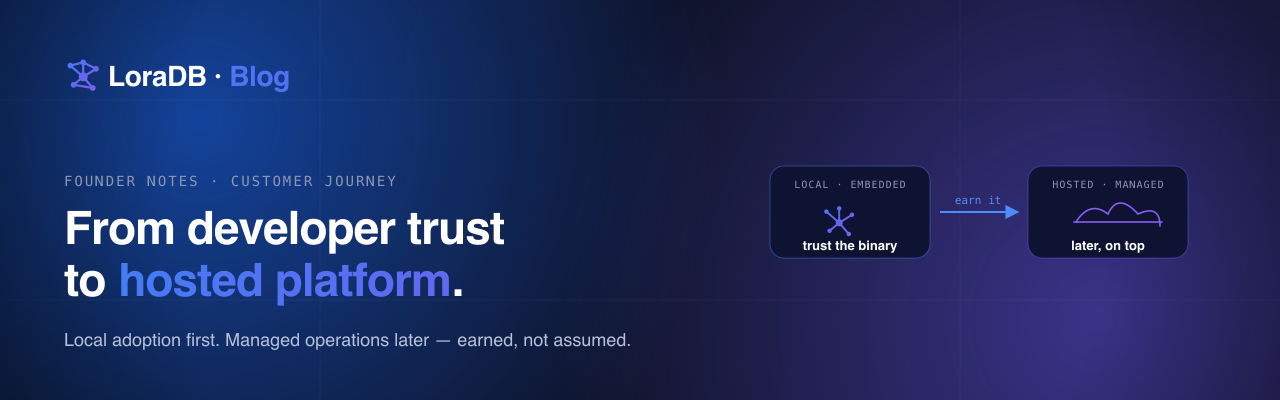
From developer trust to hosted platform — local adoption first, managed operations later.

The easiest way to misunderstand LoraDB is to see the open core and the hosted platform as separate ideas.

They are the same journey.

The core database has to be developer-first because graph databases ask for a lot of trust. You are not just storing records. You are putting relationships, paths, and product logic into a system that needs to be correct and fast. If a developer cannot run it locally, inspect it, and build confidence in the query engine, the hosted product has no foundation.

Efficient storage is the product

· 6 min read
Joost van Berkel
Author, LoraDB

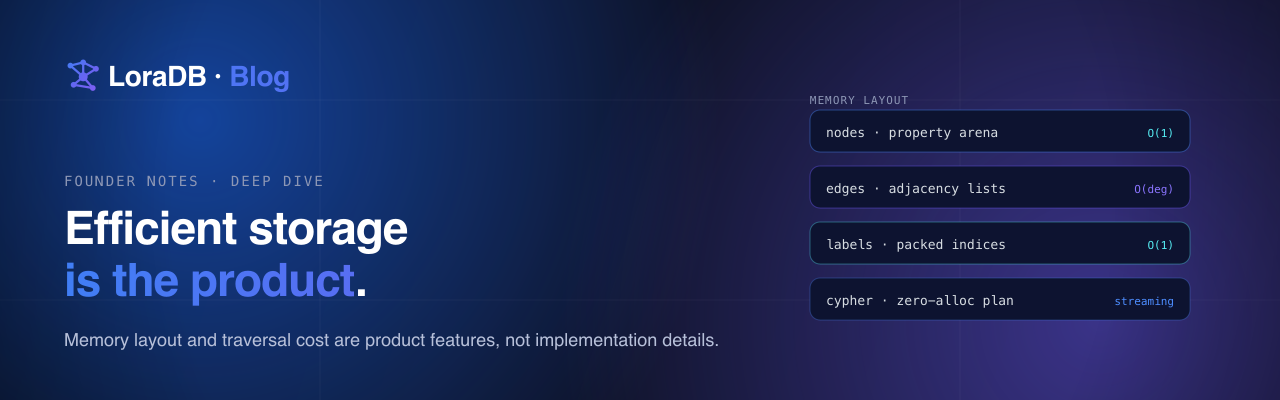
Efficient storage is the product — memory layout and traversal cost are product features.

When people talk about graph databases, they usually talk about query languages, visualizations, and relationship modeling. All of that matters. But for the kind of database I wanted, the deeper product question was storage.

If the database is in memory, storage efficiency is not an implementation detail. It is the product boundary.

Every extra allocation is less graph. Every unnecessary clone is less fan-out. Every vague data structure is a future performance mystery. A graph database can have a beautiful query language and still feel wrong if the storage layer wastes the machine.

In-memory or it does not work

· 5 min read
Joost van Berkel
Author, LoraDB

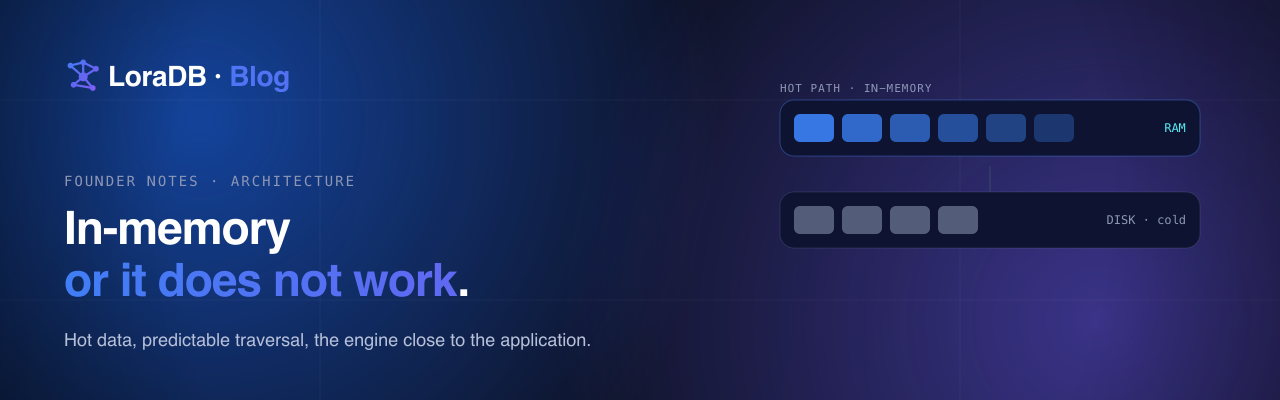
In-memory or it does not work — hot data, predictable traversal, the engine close to the application.

The phrase "in-memory database" can sound like a performance trick. For LoraDB, it is more basic than that. The product I wanted to build did not make sense if the graph was slow to touch.

Graphs are not like simple key-value lookups. The interesting queries walk. They expand. They branch. They filter while moving through relationships. A single product interaction can turn into a set of small traversals that need to feel instant.

If the graph is on the hot path, latency is not an optimization. It is the product.