
2 posts tagged with "Indexing"

Range, text, point, vector, and full-text index work.

View All Tags

LoraDB v0.16: GraphQL, and an engine that finds the seek

· 5 min read
The LoraDB team
Engineering

LoraDB v0.16 adds a GraphQL API, and a planner that no longer needs help finding an index.

The headline is a new package, @loradb/lora-graphql. One annotated schema becomes an executable GraphQL API whose operations compile to parameterised Cypher. Building it put the engine under a kind of load the Cypher examples never did, and most of this release's engine work came out of that: condition pushdown, IN seeks, early LIMIT inside transactions, temporal range indexes, writes in CALL { }, and a committed change feed.
LoraDB v0.12: Vectors, end to end

· 8 min read
The LoraDB team
Engineering

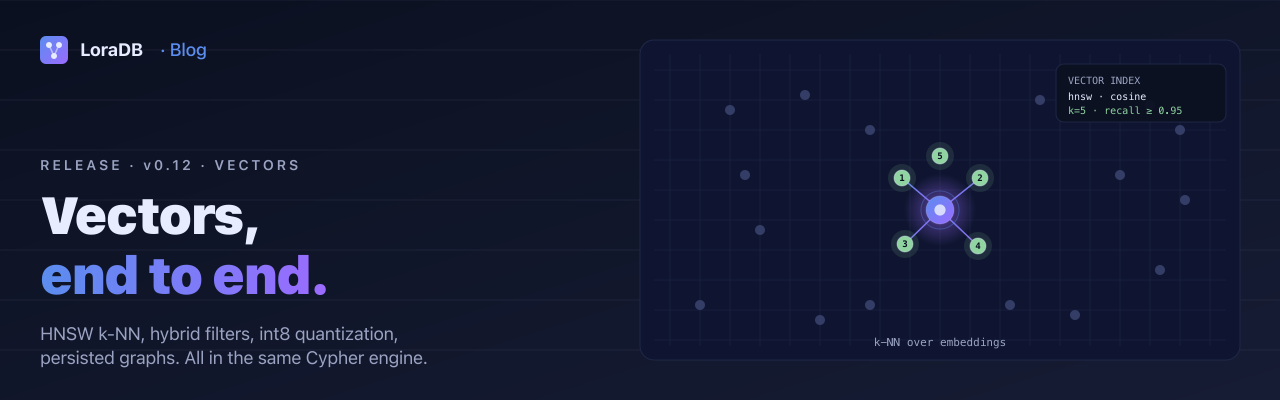
LoraDB v0.12. Vectors, end to end.

LoraDB v0.12 is a vector release.

v0.5 made the engine stream. v0.6 made persistence feel like a system. v0.7 was a process release. v0.8 made plans and runtime metrics easier to inspect. v0.9 gave the planner a schema catalog. v0.10 made the function library a library. v0.11 put the engine behind a URL at play.loradb.com.

v0.12 turns the vector type into a real index. Until this release a VECTOR value was a first-class property you could store, score, and return, but CREATE VECTOR INDEX was a catalog entry with no backing structure. Every k-NN query did a flat scan over every label-matching node. v0.12 keeps that behaviour as a deliberate fallback and adds an HNSW backend, hybrid pre-filters, four similarity metrics, int8 quantization, async populate, and snapshot persistence behind it. The playground gets a tuning wizard so none of this requires reading the catalog by hand.